Drivers often use alignment and balancing as if they were the same job. They are not, and paying for the wrong one leaves the original fault in place while the bill grows.
Alignment sets the angles of the wheels relative to the car. Balancing corrects the distribution of weight around each wheel and tyre. The symptoms they produce are usually quite different once you know what to feel for.
Key facts
- Vibration through the steering wheel at a narrow speed band usually means balancing.
- A pull or an off-centre steering wheel usually means alignment.
- Balancing is done with the wheel off the car; alignment is measured with the car on its wheels.
- New tyres need balancing; suspension work needs alignment.
Contents
- Two different jobs
- Vibration clues
- Tyre wear clues
- How balancing works
- How alignment works
- Doing both in the right order
- When to replace instead
Two different jobs
Balancing corrects an imbalance in the wheel and tyre assembly by adding small weights to the rim. An unbalanced wheel shakes because its mass is not evenly distributed around the axle.
Alignment adjusts the suspension so all four wheels point in the intended directions. A misaligned wheel does not shake; it drags, which scrubs rubber and pulls the car off line.
Vibration clues
If the steering wheel shudders between roughly 50 and 70 mph and settles above or below that band, front wheel balance is the first suspect. Vibration felt through the seat at similar speeds points to the rear wheels.
A shake that appears only under braking is usually a warped disc or a brake fault, not balancing. A vibration that worsens with speed without a clear band can be a worn CV joint, a bent rim or a failing wheel bearing.

Tyre wear clues
Feathered tread, where one edge of each tread block is higher than the other, is a classic toe problem. A smooth, even scrub on one inner or outer shoulder points to camber.
A single flat spot usually means a locked wheel under braking or a badly balanced assembly left too long, not alignment. Look at all four tyres before deciding, and note which axle is worse.

How balancing works
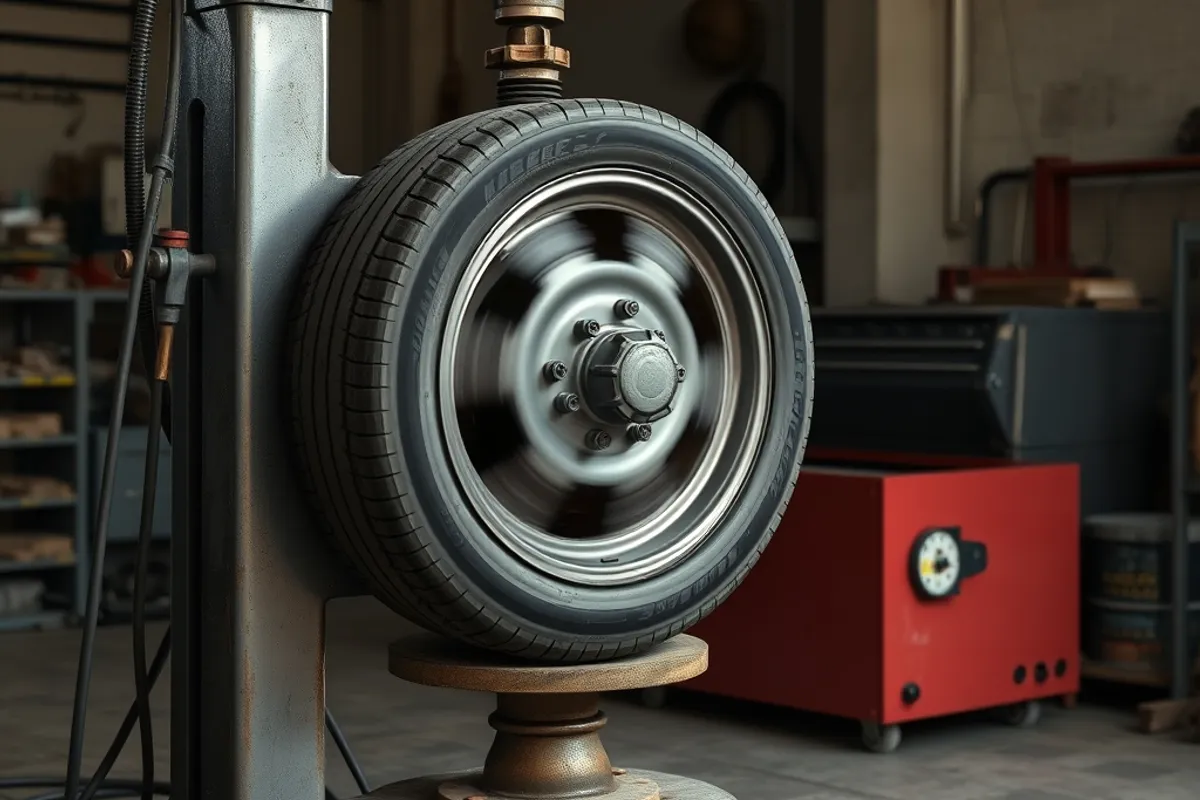
The wheel is removed, mounted on a balancer and spun. The machine reports the position and size of the imbalance, and the technician fits clip-on or adhesive weights to the rim.
A good job includes checking the rim for runout and the tyre for a shifted belt. Balancing a bent wheel simply hides the problem at one speed and reveals it at another.
Vibration tells you about weight. Direction tells you about angles. Learn to separate the two and you stop paying twice.
How alignment works
Targets or sensors are fitted to all four wheels and the car is measured on a level ramp. The technician compares the figures with the manufacturer's range, then adjusts tie rods, camber bolts or shims where the car allows.
The job finishes with a road test and a centring of the steering wheel. If the wheel is still crooked afterwards, the adjustment was not finished.

Doing both in the right order
When new tyres are fitted, balance them first, then check alignment. There is no point aligning a wheel that will be rebalanced, and no point balancing a car whose geometry will scrub the new rubber within weeks.
After a kerb strike, do both. The impact can bend a rim and move the toe at the same time, which is why a single job often fails to cure the complaint.
When to replace instead
A tyre with a shifted belt, a bulge or a repaired sidewall cannot be balanced back to health. A buckled alloy may be repairable, but the cost often approaches a replacement wheel.
If balancing needs repeating at every service, look for a bent wheel, a worn hub face or a tyre that is simply out of round. For the geometry side, our wheel alignment guide covers the angles and what a proper check costs.